
How to start a daily journaling habit and actually keep it
Most journaling attempts fail in week two. Here's why, and how a lighter approach makes all the difference.
Most people start journaling the same way: motivated, with a fresh notebook or a new app, writing a full page about their day. And most people stop within two weeks. Not because journaling is bad, but because they started too big.
The goal of daily journaling is not to produce great writing. It is to create a small, repeatable moment of reflection that, over weeks and months, builds into something surprisingly useful.
Why most journaling habits fail
There are three common reasons a journaling habit collapses:
- The blank page problem. Without structure, the question “what do I write?” has no answer on an average Wednesday evening. You stare, write nothing, and skip it.
- The all-or-nothing trap. You miss one day, feel like you’ve broken the streak, and decide to start fresh “next month.”
- The bar is too high. If journaling means writing a thousand words, you will avoid it whenever you’re tired, busy, or uninspired, which is most days.
The fix is not discipline. It is reducing the bar until skipping feels stranger than writing.
The 30-second rule
A daily journal entry does not need to be long. It needs to exist. Even a single sentence like “Long meeting, tired, had good pasta” counts. Written down, it becomes a data point. Fifteen of those data points reveal a pattern. Sixty of them show you something about yourself that you would never have noticed otherwise.
The goal for the first month is not insight. It is just showing up.
What to write when you have nothing to say
Pick two or three of these (not all of them) and answer them briefly each day:
- One thing that happened today
- One thing I am looking forward to tomorrow
- Energy level: low / medium / high
- One small win, however unremarkable
- One thing I would do differently
This is not a template you fill every field of. It is a menu you pick from. Some days you write three lines. Some days one. Both count.
Opening Daykept and writing your first entry
Tap +. Pick how you feel (one tap, from 50 emotions in six groups), then write in the title, the body, or both. Today's question waits in the empty page as a hint, but there is no prompt you must answer and no format you must follow.
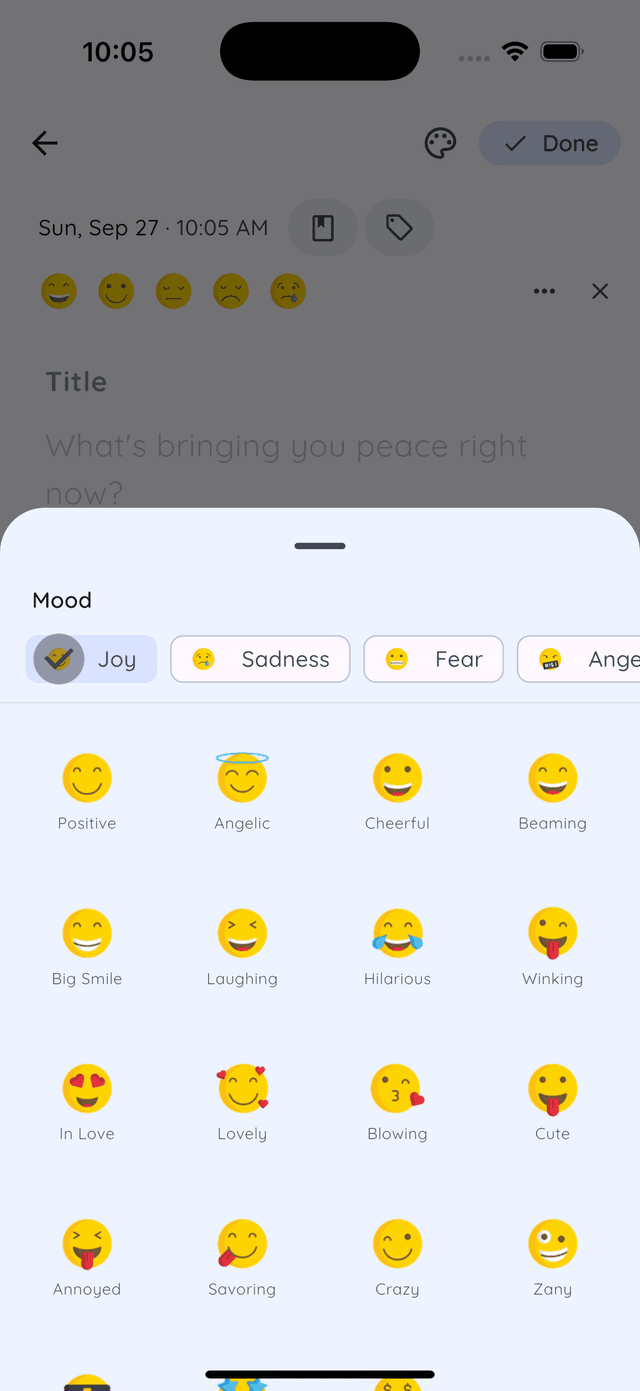
You can also add photos, pull in a template or record a voice note (Premium · free during early access). Ignore all of that for the first two weeks. Plain text is faster and removes every excuse not to start.
Put the habit where you will see it
Memory is a bad reminder system. Two things do the remembering for you:
- A reminder at your quiet moment. Morning, midday, evening or your own time, every day or weekdays only. It arrives with a question, so you are never starting from nothing.
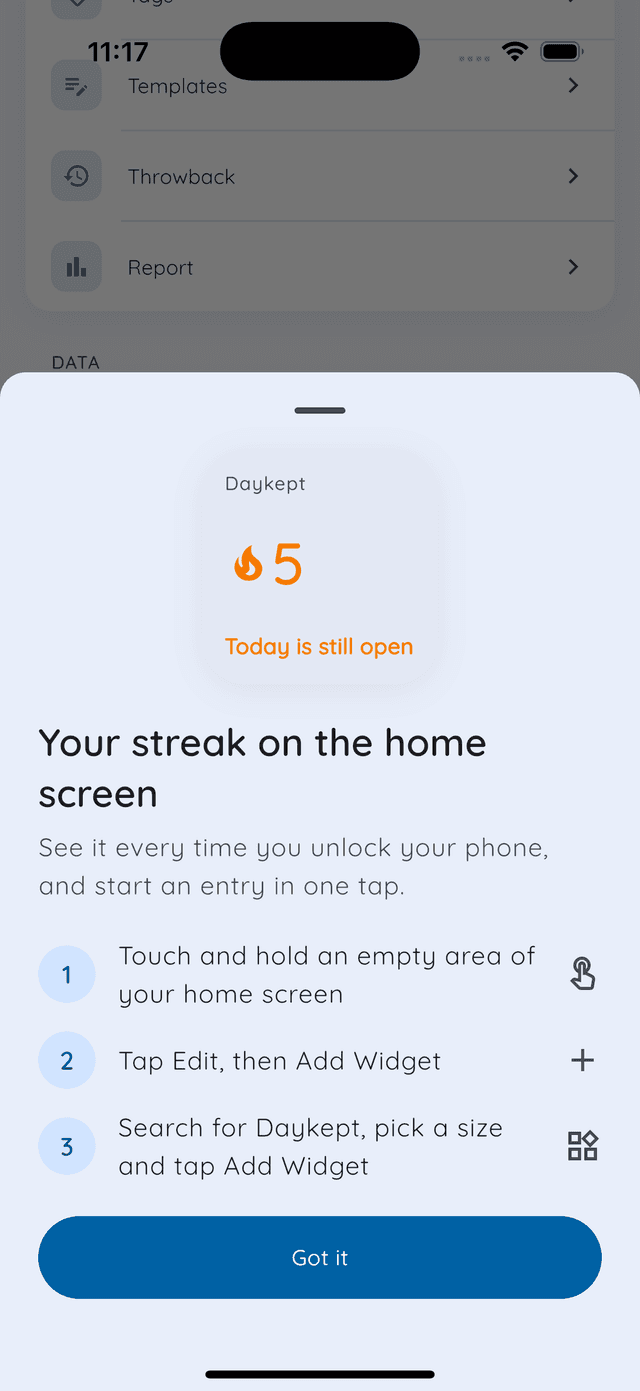
- The home screen widget. It shows your streak and whether today is still open, and starts a new entry in one tap, right there every time you unlock your phone.
What the habit looks like after two weeks
After two weeks of daily entries, even short ones, your home timeline starts to look like a real record. You can scroll back to last Tuesday and remember what you were thinking. That recall is useful in a way that feels small until the first time you actually need it.
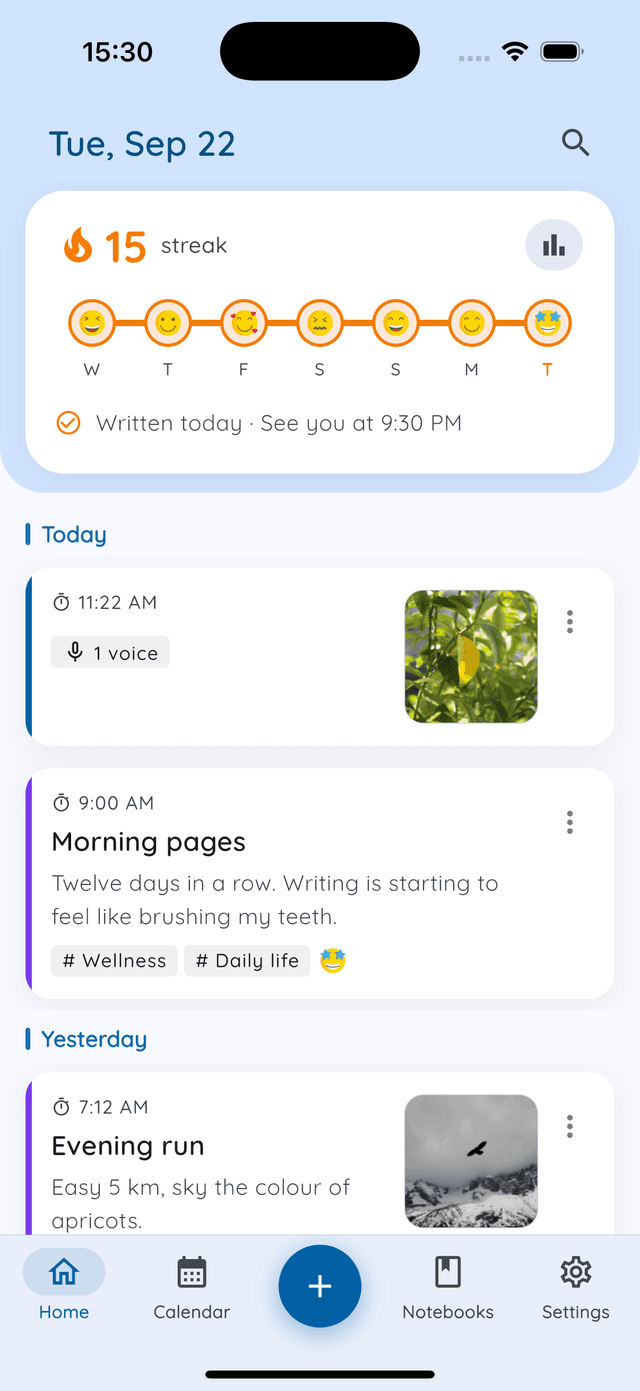
More importantly: the habit feels lighter because you have evidence that you are someone who does it. Identity follows action. After two weeks of small entries, you are a person who journals, not someone who is “trying to journal.”
The one rule that makes the habit stick
Never miss two days in a row.
Miss one day: fine, life happens. Daykept's streak has grace days, so one missed day doesn't erase it. Research backs this up: in a study of people building a new daily habit, missing a single day had little effect on how automatic the habit became. The same study found it took 66 days on average for a habit to feel automatic, ranging from 18 to 254 (Lally et al., 2010), so if it still takes effort after two weeks, that's normal, not failure. Miss two: the gap starts to feel permanent. Write one sentence the day after a skip and carry on, without needing to “catch up.” There is nothing to catch up on. Each day is its own entry, its own opportunity.
Start small, show up often, and let the record build itself.
Ready to understand what to do with your entries once you have them? Read how to organize your journal with tags and notebooks. Or learn about the weekly review that turns your entries into actual insight.
Free templates for this: Morning Intentions, 5-Minute Journal. Each one has the exact questions, a filled-in example and how to open it in Daykept.
Try Daykept, a gentle journal built around how you feel
Free to download. Writing is free forever. No account needed to start.
Learn more →