
How to keep a mood journal (and actually see the patterns)
A mood journal works when it's quick enough to keep and clear enough to read back. How to log your mood, what to write, and how to spot the patterns.
A mood journal is simple: every day, you note how you feel. The hard part is keeping it going — and then reading it back in a way that tells you something. Most people stop at step one.
Here's how to make both parts easy.
Why keep a mood journal
Moods feel random in the moment. Over a few weeks they usually aren't. A bad Monday every week, a dip after nights of poor sleep, a lift on days you get outside — these only show up when you can see many days at once.
A mood journal gives you that view. It won't explain everything, but it turns "I've been off lately" into something you can look at: when, how often, and what was going on.
Step 1: Log the mood first, then write (or don't)
The biggest reason mood journals fail is that they feel like homework. Make the mood the only thing you have to do. Writing is a bonus.
In Daykept, every entry starts with a mood. You pick one of 50, sorted into six groups — joy, sadness, fear, anger, neutral and a few others — so you can find the right word without scrolling forever. On a busy day that's the whole entry, and it takes ten seconds. On other days, keep going and write.
Step 2: Add one line of context
A mood with no context is hard to learn from. One line is enough:
- What happened today?
- What might have set this feeling off?
- What helped, if anything did?
If you like structure, Daykept's free Mood Journal template asks exactly these three things: How am I feeling right now? What might have set this off? What helps when I feel this way?
Step 3: Tag what repeats
Tags are how context becomes searchable. Keep it short — five or six tags you'll actually use, like Work, Sleep, Family, Exercise, Health. Add one or two to an entry when they're relevant.
Later, you can filter your calendar by a tag and see whether hard days cluster around it. See how to use journal tags to spot patterns.
Step 4: Read it back — weekly, not daily
Looking at your mood every day is mostly noise. Once a week is where patterns start to appear.
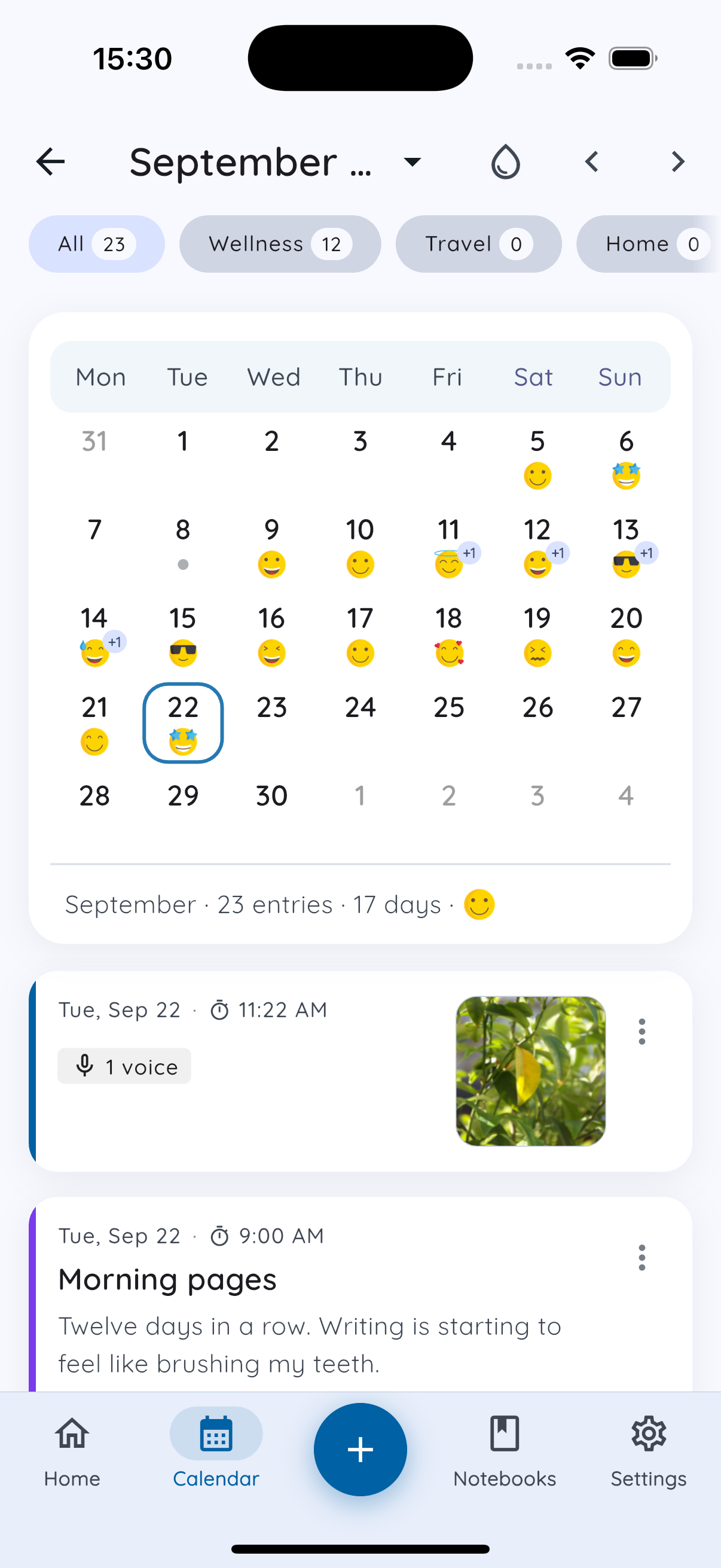
- The mood calendar shows a month at a glance, one mood per day. Tap any day to read what you wrote.
- Report shows your mood distribution for a week, a month or a year, and which days of the week you write most.
- Weekly recap appears on your Home screen on Sunday evening and Monday: how many days you wrote and a way into that week's report.
Questions worth asking when you read back:
- Which mood showed up most this week?
- Is there a day of the week that's reliably harder?
- Do the hard days share a tag?
- What was going on during the best days?
Step 5: Give it a month before judging
One week is an anecdote. A month starts to be a pattern. Three months is where it gets genuinely useful — you can compare seasons, busy periods and quiet ones.
If you track your cycle, you can go one step further and see how your mood moves across it: see mood and your menstrual cycle.
A mood journal is not a diagnosis
A mood journal helps you notice. It doesn't replace talking to someone. If low moods last for weeks, or start getting in the way of your life, bring it to a doctor or therapist — and bring your journal too. A few months of honest entries can say a lot in a short appointment.
Start today
Pick today's mood. Add one line about why. Do the same tomorrow. In a month, read it back — you'll likely find something you didn't know you were carrying.
Try Daykept — a gentle journal built around how you feel
Free to download. Writing is free forever. No account needed to start.
Learn more →