How much can I spend until payday? Work out a daily number in 4 steps
Take what's in your account this morning, subtract the bills due before payday, divide by the days left. A worked example and the 3 mistakes to avoid.
It's the 19th. Payday is the 1st. You have some money in checking, a few bills still to come, and a dinner invitation tonight. The question isn't "how much is in my account", it's how much of it can I spend today and still make it to payday?
You can answer that in about two minutes, with a number that changes every day as you spend. Here's the method, a worked example, and the mistakes that make the number wrong.
The 4-step formula
- Start with what your everyday money holds this morning. Checking, cash in your wallet, and any card you pay off in full (subtract what's on it). Use this morning's balance, before anything you've spent today.
- Subtract every bill due before payday. Rent, phone, insurance, subscriptions: anything that will come out between today and the day your pay arrives.
- Divide by the days left. Count today, don't count payday itself (that money arrives with it).
- Subtract what you've already spent today. What's left is today's number.
In one line: (balance this morning − bills before payday) ÷ days left − spent today.
A worked example
It's the 19th of a 30-day month and you're paid on the 1st, so there are 12 days to cover, today included.
| Amount | |
|---|---|
| Checking this morning | $2,140 |
| Phone (22nd) | −$55 |
| Internet (24th) | −$65 |
| Car insurance (27th) | −$460 |
| Streaming (28th) | −$15 |
| Gym (30th) | −$45 |
| Left until payday | $1,500 |
| Per day, for 12 days | $125 |
(Example numbers. Use your own.)
You've had a $23 lunch already, so $102 is left for today. That's your answer for the dinner invitation.
The useful part is what happens next. Spend less than your share and the next days get a little more; spend more and they get a little less:
- Spend $95 today: tomorrow's share is ($1,500 − $95) ÷ 11 = $127.73.
- Spend $180 today: tomorrow's share is ($1,500 − $180) ÷ 11 = $120.
A bad day doesn't break the plan. It spreads over the days that are left, so you see the cost straight away instead of on the 29th.
3 mistakes that make the number wrong
1. Forgetting bills that don't come every month. A $139 yearly subscription or a car insurance payment every six months is easy to miss. Miss that $139 and you'll think you have $125 a day when you really have $113.42. Put yearly and quarterly bills somewhere you'll see them, or set money aside for them with sinking funds.
2. Counting your savings. If $3,000 in savings goes into step 1, the example jumps from $125 to $375 a day. Savings is money you've already decided not to spend. Leave it out, along with investments and anything you owe on a loan.
3. Counting money that hasn't arrived. A freelance payment "due next week" or a tax refund isn't spending money until it lands. Add an unpaid $600 and $125 becomes $175 a day. If it's late, the last days before payday are the ones that go short.
When the number is negative
If the bills before payday add up to more than your balance, the formula gives you a negative number. With $520 this morning and the same $640 of bills, you're $120 short before payday, before buying anything.
That's worth knowing on the 19th rather than the 30th. A few things that help, in the order to try them:
- Move a due date. Many phone carriers, insurers and lenders let you pick or change the date a bill is taken. One bill moved past payday fixes this month.
- Pause what you can. A streaming service or a gym can usually wait a month.
- If you use savings, move one exact amount. Transfer what covers the gap, once, instead of dipping in every few days.
Doing it by hand, in a spreadsheet, or in an app
| By hand | Spreadsheet | App linked to your bank | Cashvelope | |
|---|---|---|---|---|
| Setup | None | A sheet with your bills and a formula | Bank login | Add your accounts and bills once |
| Balance | You look it up | You type it in | Updated from your bank | From what you log, no bank login |
| Bills before payday | You list them each time | Listed once, dates updated by you | Depends on the app | Taken from the bills you've scheduled |
| Today's number | Worked out when you remember | When you open the sheet | Depends on the app | On Home, every day |
| Cost | Free | Free | Varies | Free (Pro is optional) |
By hand works fine if you do it every few days. It goes wrong when the dates move and you work it out from last week's list.
How Cashvelope works this out for you
Cashvelope does this calculation on Home every day. To spend today starts from what your everyday accounts and cards hold, minus the bills you've scheduled before payday, and spreads the rest evenly over the days left. Savings, investments and loans are left out.
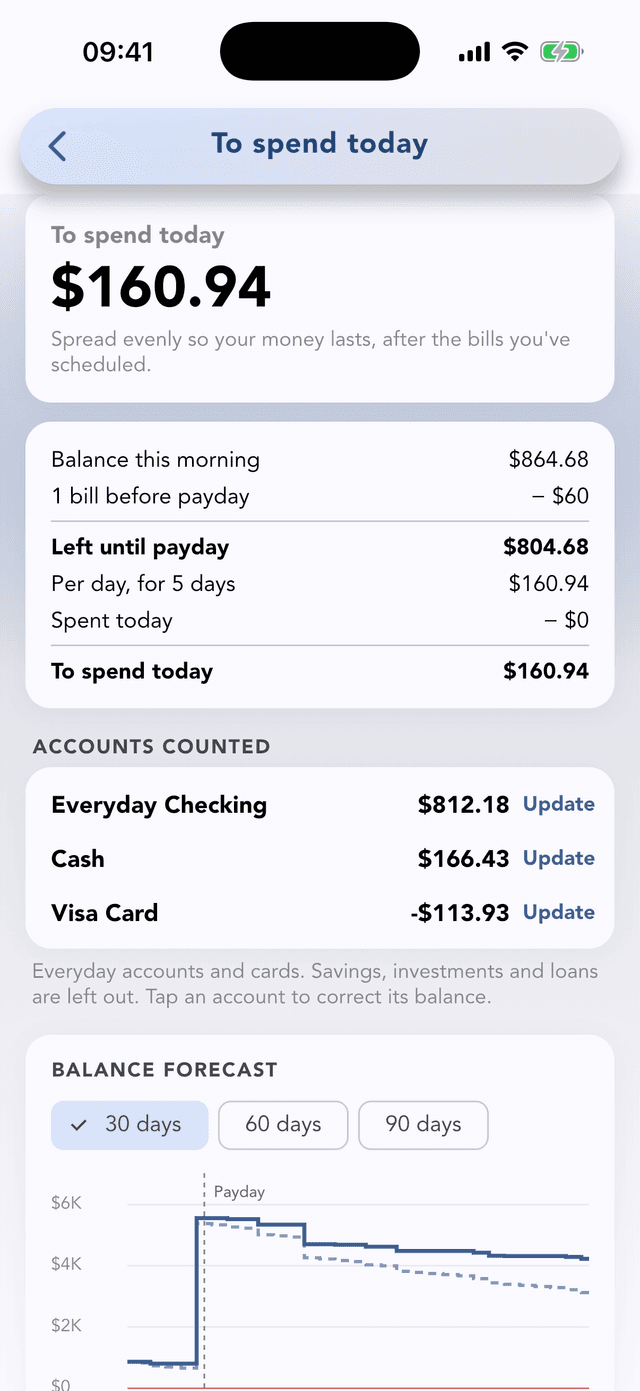
- Payday from your income. Add your salary as a recurring income and the figure counts down to it. No payday set? It counts to the end of the month.
- The bills are the ones you've scheduled. Rent, phone and subscriptions you add as recurring payments are taken off before the money is split. A bill you haven't added isn't counted, so add the big ones first.
- It tells you when you're over. Spend more than today's share and Home shows Over today by $8 instead of a number to spend. If your scheduled bills are more than your balance, it shows Short before payday.
- No bank login. You log what you spend, so the balance is the one you've recorded. If it drifts, you correct the account's balance on the same page.
With Cashvelope Pro, the same page can also show your balance 30, 60 or 90 days ahead and warn you a few days before it may drop below zero. That's an estimate from your scheduled bills and income, plus your usual spending.
Paid every two weeks? The same idea works per paycheck: see how to budget by paycheck.
FAQ
How much should I spend per day? There's no right amount for everyone. The formula gives you what your money allows after bills: (balance this morning − bills before payday) ÷ days left. If that's lower than you need, the fix is in the bills or the income, not the daily number.
Should I include my credit card? If you pay it off in full each month, yes: subtract what's on it from your balance, because that money is already spent. If you carry a balance from month to month, you could count only this month's payment as a bill instead. Cashvelope subtracts the whole card balance, which keeps the daily number on the safe side.
What if I'm paid every two weeks? Use your next payday, whatever date it falls on. The days left are shorter, and so is the list of bills.
Is "safe to spend" the same as my balance? No. Your balance includes money that's already promised to bills. What you can safely spend is the balance minus those bills, split over the days until you're paid again.