How to budget by paycheck: biweekly, weekly or monthly pay
Monthly bills, biweekly pay: assign each bill to a paycheck, balance the two halves, and know what's left to spend until the next payday.
Most budgeting advice assumes you're paid once a month. Most people aren't. When rent is due on the 1st but money arrives every other Friday, a monthly budget always feels wrong: flush one week, broke the next.
The fix is to budget each paycheck, not each month. Here's how, with a worked example.
Why monthly budgets fight biweekly pay
- Bills are monthly, pay isn't. Rent, car payment and phone come once a month on fixed dates. Your pay lands every 14 days, on a different date each month.
- Some months have three paychecks. 26 paychecks a year means two months get a third one. A monthly budget either ignores it or quietly spends it.
- "Monthly remaining" hides timing. $900 left for the month means little if $1,350 of rent comes out before your next payday.
Step 1: List your bills by due date
Write down every fixed bill with its amount and due date. Include subscriptions and insurance, and anything billed quarterly or yearly (divide by 3 or 12).
Step 2: Assign each bill to a paycheck
Each bill gets paid from the paycheck that arrives before its due date. With pay on roughly the 1st and 15th:
- Paycheck A (around the 1st) covers bills due from the 1st to the 14th.
- Paycheck B (around the 15th) covers bills due from the 15th to the end of the month.
Step 3: See what's left in each half — then balance them
Example: $2,100 every two weeks.
| Paycheck A | Paycheck B | |
|---|---|---|
| Pay | $2,100 | $2,100 |
| Rent (due 1st) | −$1,350 | |
| Insurance (5th) | −$120 | |
| Car payment (15th) | −$280 | |
| Phone (20th) | −$60 | |
| Utilities (25th) | −$140 | |
| Subscriptions | −$45 | |
| Savings | −$500 | |
| Left for two weeks | $630 | $1,075 |
(Example numbers — use your own.)
Paycheck A is tight because rent lands in it. Two ways to even it out:
- Carry money forward. Leave $220 of paycheck B untouched for the next A. Now both halves have about $850 for everyday spending.
- Move a due date. Many lenders, phone carriers and insurers let you pick the due date. Moving one bill into the other half fixes it for good.
Step 4: Give the rest a two-week limit
What's left is your flexible money for 14 days: food, getting around, fun. Put a limit on the categories that leak — usually eating out and shopping — and leave the rest unlimited but logged. The method is the same as digital cash envelopes, with a two-week envelope instead of a monthly one.
Step 5: Decide what the third paycheck is for — before it arrives
Twice a year you get a paycheck with no rent in it. Decide now where it goes: an emergency fund, sinking funds for irregular bills, or extra on a debt. Money you haven't decided on gets spent.
Weekly pay and monthly salary
- Weekly: same idea with four or five paychecks a month. Assign bills to the week before they're due, and set a weekly limit for groceries and fun.
- Monthly salary: you still get the timing problem at the end of the month. Split the month into two halves anyway — it stops the "day 20, nothing left" pattern.
Doing this in Cashvelope
Cashvelope doesn't split your paycheck for you — you do Steps 1–3 once, on paper or in a spreadsheet. What the app handles is the part that goes wrong between paydays: knowing what's left.
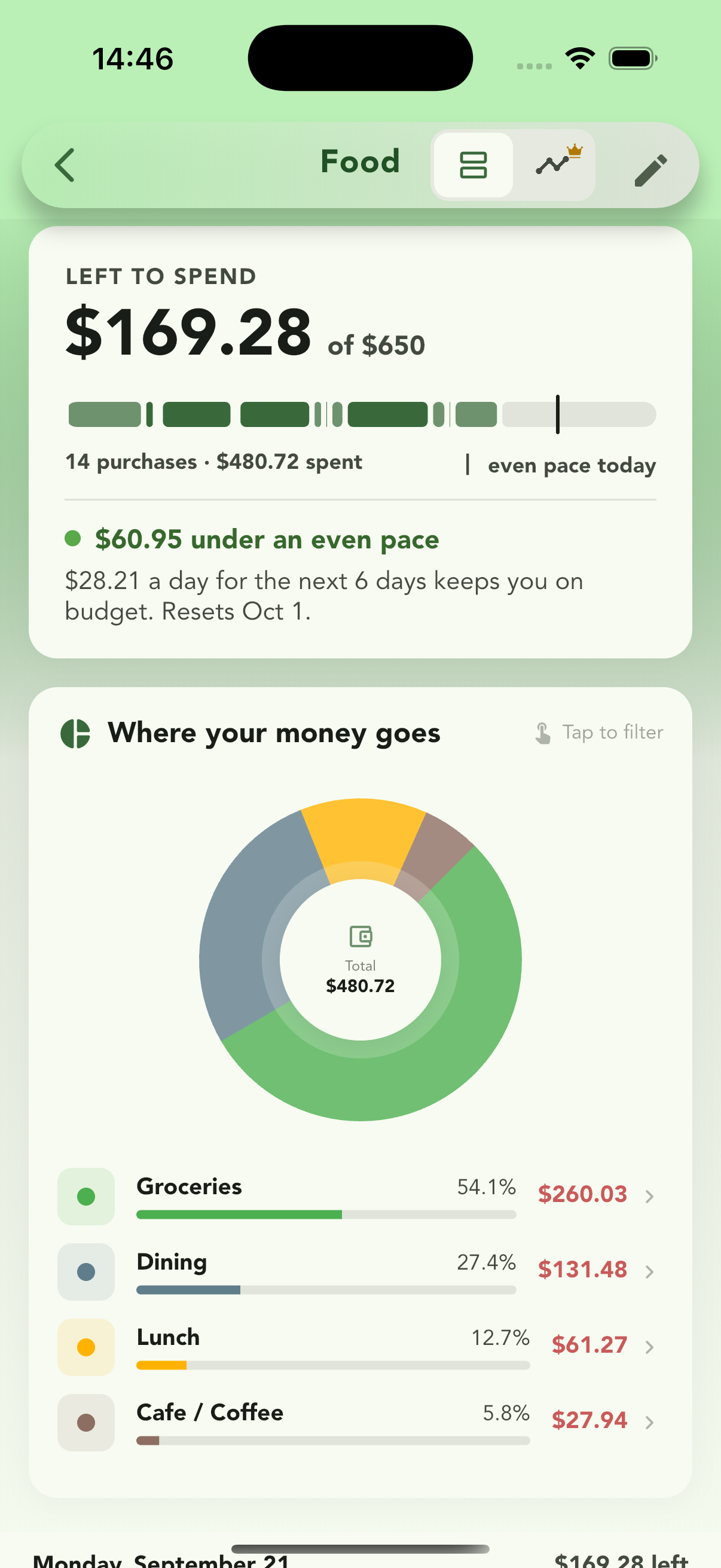
- A budget that matches your pay. Create a budget, set it to repeat every 2 weeks (or every week), and pick your payday as the start date. It resets itself every payday — nothing to recreate.
- What's left and a daily amount. The budget shows left to spend and "$X a day for the next N days keeps you on budget" — so day 9 of 14 has a number, not a feeling.
- Spending goals split the budget into groceries, eating out and fun, as amounts or percentages.
- Bills on one page. Add rent and other bills as recurring transactions with reminders; the Subscriptions page lists them by date with monthly and yearly totals.
- Savings as a transfer. Move your savings amount to a savings account with Transfer on payday — it isn't counted as spending.
Up to five active budgets are free. See how budgets work for the full budget screen.
FAQ
Should I budget biweekly or monthly if I'm paid biweekly? Budget spending biweekly, track bills monthly. The two-week limit matches when you actually have money; the monthly view is for reports.
What do I do with the two extra paychecks a year? Decide in January. A common split: part to an emergency fund, part to sinking funds for irregular bills, a little for something fun.
My paycheck changes every time. Does this still work? Plan on your lowest typical paycheck. Anything above it goes to savings or next period's buffer.